
AutoCart
A vehicle marketplace for Ireland and the UK.
- Role
- Engineer · mobile, backend, admin & website
- Context
- Client project
- Timeline
- 2026 – now
- Platforms
- iOS · Android · Admin · Website
- Stack
- React Native · TypeScript · Node · PostgreSQL · Typesense · Next.js
AutoCart is a marketplace for cars, vans, motorbikes and parts in Ireland and the UK. On this client project I built the iOS and Android app, the backend and the website, and built out the admin the team reviews listings in.







Inside the product
One admin for the whole marketplace.
Users, listings, stories, billing, support and moderation, with the queues waiting on the team counted up front.
Browse with a swipe.
One listing at a time, with the photos, the price and the seller up front.
Every angle.
Page through a listing’s photos, or jump to one from the strip.
The seller and the price, up front.
Trade or private, when they joined, their rating, and a monthly figure beside the price.
Scan a plate, skip the typing.
The camera reads the registration, Irish or British, and the app looks the car up.
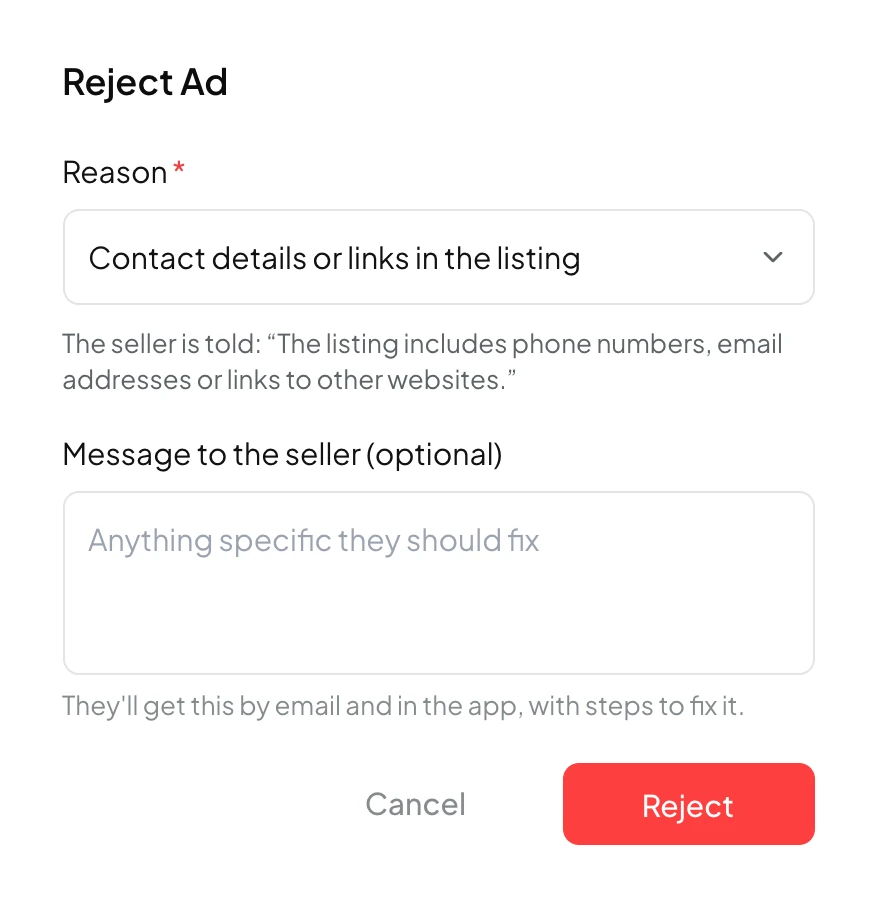
Every rejection says why.
The admin picks a reason; the seller gets its sentence and the steps to fix it, in the app and by email.
A website that sells the app.
Features, plans and how it works, for buyers and sellers in Ireland and the UK.
Built with
- React Native
- TypeScript
- Next.js
- Node.js
- Express
- PostgreSQL
- Prisma
- Redis
- BullMQ
- Typesense
- Socket.io
- OpenRouter
- AWS EC2
- AWS S3
- Firebase
- RevenueCat
- Sentry
The problem
Selling a car means typing out everything a buyer will check: make, model, year, mileage, the NCT or MOT, the price. Buying one means describing what you want in a way the site understands. AutoCart is a marketplace for both sides in Ireland and the UK, for private sellers, dealers and brands, from cars and vans to parts and mopeds.
The job is to make both sides faster without making the site less trustworthy. A listing should start from a few photos and a search from a sentence, while every listing stays real and priced by the person selling it. And all of it has to work in two markets, with two currencies, two plate formats and two roadworthiness tests.
My role
I’ve worked on AutoCart since the app’s first commit in February 2026 and wrote 969 of the 971 commits across its four codebases. The admin began as a set of screens by another developer; I connected it to the backend and have built on it since, from rejection reasons to managing a seller’s trial.
That covers the React Native app, with its listings, search, messaging, stories and plate scanner; the Node API on PostgreSQL with Typesense search, shared by all three clients; seller plans through RevenueCat; push notifications; the AI search and AI-drafted listings; and the website’s share and legal pages.
The AI picks filters, not cars
The problem
People describe the car they want in a sentence: “something sporty for a young family, budget 20 grand”. A language model can read that. But if the model chooses or describes the results, it can show a car that isn’t for sale, or one that doesn’t match what was asked.
What we chose
The model only proposes filter values, and each one is checked against AutoCart’s own makes, models, counties and categories. Anything it invents is dropped and reported. A rule-based parser runs alongside it and wins on any field it’s sure of, such as a price. The normal search then runs, so every listing shown is real and matches. The app shows what it understood before any results, and says so when it corrects a typo.
The trade-off
Two parsers to keep in step, and word lists that need tending. Any word left over becomes a text filter, so a stray one narrows the results: “5 door hatchback” once hid every hatchback listed as “5dr”.
“The model never picks the results and never sees an ad.”
Header of the AI search parser
Photos make a draft, never a price
The problem
A listing is a long form: make, model, year, body, fuel, colour, description. A model can read much of that from the photos. But a wrong value the seller doesn’t notice goes straight into a live ad, and a model made to fill every field is pushed to invent the ones it can’t see.
What we chose
The photos produce a draft the seller checks before anything goes live. The plate lookup supplies the car’s facts; the model fills only the gaps and writes the title and description. “I can’t tell” is a valid answer, every value is checked against the same lists the search uses, and the price never comes from the model. If one model fails or times out, the next takes over, up to three, inside one 45-second budget.
The trade-off
The draft saves less typing than it could: the seller always sets the price and checks each field. When the photos can’t be read, the app offers Change Photos or Enter Manually instead of a Retry that would get the same answer.
“It may say what it sees; it may not say what that is worth.”
Header of the AI ad-draft service
Paid listings go on top, not into the order
The problem
Sellers can pay for Spotlight, which puts a listing at the top of the feed for 20 days. The feed loads page by page, with a cursor on date and ID. Sorting it by “is paid” breaks that cursor: page two skips ordinary listings and shows paid ones again.
What we chose
Paid placement is an overlay. Up to four Spotlight listings sit in a row above the unchanged newest-first feed, rotated among everyone currently paying, and left out of the feed below on every page so none shows twice. A rotation holds while someone pages through. When a shopper picks an order themselves, newest or by price, the paid row steps aside, and paid rows are labelled Spotlight.
The trade-off
Each feed page runs two extra queries for the paid row, and a paid listing leads only the default order. If the paid row fails to load, the feed shows without it.
“The keyset stream is never re-ordered.”
Comment in the ranking module
The country travels with the car
The problem
AutoCart serves Ireland and the UK: euro or pounds, the NCT or the MOT, two plate formats, and Northern Ireland on the UK side. Parts of the app assumed Ireland. A live UK listing showed its price in euro, and a UK plate read with one wrong character was looked up as Irish.
What we chose
Every listing carries its country. The plate reader’s region sets it, the price follows where the ad is, and the test name follows the plate: NCT for Irish cars, MOT for UK ones. Which places people can browse from is the server’s call, so adding a market is a configuration change, not an app release.
The trade-off
The app keeps a copy of the market list for older servers that don’t send one, and that copy drifted once: it still listed Switzerland after the markets changed. A test now pins it to the server’s list. With no answer at all, the app lets a place through rather than lock everyone out.
“Everywhere else the server’s answer wins — duplicating the policy in two places is how the two come to disagree.”
Comment on the app’s fallback market list

A rejection always says why
The problem
Most new listings wait for the admin team’s review before they go live. Rejecting one used to be a bare confirmation that set the status, so the seller got a generic notice and nothing to fix.
What we chose
Reject now asks for a reason from a fixed list of ten, from wrong category and poor photos to suspected scam. Each reason carries the sentence the seller reads and the steps to fix it. The admin sees that sentence before confirming, the app shows it on the listing, and the email lists the fixes. The list lives in the backend, so all three say the same thing.
The trade-off
A fixed list can’t cover every case. “Other” needs a written message, and a new kind of problem means changing the backend’s list.
“Reject used to be a bare ‘Are you sure?’ that set status REJECTED, so the seller learned nothing.”
Commit message in the admin
Where it is now
- 960+
- commits of mine across the four codebases
- 4,700+
- automated tests across the app, the backend and the website
- 2
- markets, Ireland and the UK, from one app and one backend
AutoCart is in active development: the app reached version 1.0.79 on 18 November 2026, and the app, the admin and the website all run on the one backend. It’s a client project, so this page covers how it was built, not how it’s doing.
What I’d take to the next product: keep one source of truth and check everything against it. The AI’s answers meet AutoCart’s own lists before they reach a search or a listing, and the markets and rejection reasons live in the backend, where every client reads the same words.